


Buy⚔️ for a gift and for collecting Austrian Infantry Officer’s saber sample 1861 in Ukraine city of Kiev
Dear Collectors and guests of the site Antique Gallery, looking for a gift, in particular Antique weapons, your attention is invited: Austrian Infantry Officer’s saber of the sample of 1861.
Feel the breath of history with this exquisite Austrian infantry officer’s saber from 1861! ?️ Crafted with remarkable craftsmanship, this saber is a symbol of the elegance and military grandeur of the Austro-Hungarian Empire. It will be a unique addition to any collection of antique weapons, emphasizing your refined taste and passion for history. Don’t miss the opportunity to own this unique artifact! ?
The blade of the saber is nickel-plated steel, narrow, slight curvature, single-bladed (the fighting end is double-bladed, the point is on the center line), single-bladed, with a dedicated heel.
The hilt of the saber consists of a hilt and grip. The hilt is wooden, covered with sharkskin; straight, oval in cross-section, with a beveled upper part, wrapped along nine transverse grooves with triple wire (twisted and smooth).
The back of the hilt is covered with a concave metal bar, smoothly passing into a rounded head, fixed with an oval nut on the blade shank. At the bottom of the crossguard, the hilt is intercepted by a profiled bushing of oval cross-section.
The guard is white metal, formed by a protective shackle with a bend reminiscent of the “blucher” shackle. Almost at right angles, it transitions into a diamond-shaped cross with two parallel slits at the opposite end and a wave-shaped termination.
The scabbard of the saber is all-metal. The device includes two collars (the upper one with a soldered bracket, the lower one with a ring) and a narrow shoe.

Historical Background:
The Austrian infantry officer’s saber of 1861 is a cold weapon used by officers of the Austrian army after its introduction in 1861, replacing the saber of 1854 . This saber became widespread not only in Austria, but also in neighboring countries. For example, in May 1867, the Serbian military’s supplier Lazar Trifkovic gave Montenegro about 500 Austrian sabers, among which were the 1861 models. This model was popular among Montenegrin officers, remaining in service longer than other models. In 1880, Montenegrin Minister of Defense Ilija Plamenac purchased another 300 of these sabers. The saber has a slightly curved, single-bladed blade with a single lob. The combat end is double-bladed, rhombic in cross-section. The hilt consists of a handle with a head and a steel grip. The wooden hilt is covered with“sharkskin” and wrapped with twisted wire, which gives it durability and ease of use. The back of the hilt is covered with a steel bar with an extension in the middle part, which transitions into a rounded head. The garda is formed by a crossguard and a front convex V-shape a narrow symmetrical cup with two rectangular slots for the hilt on the edge side of the blade. The scabbard is made of steel, with two nuts and a shoe. The upper nut has a brace on the inside, and the lower nut has a fixed ring for a portcullis. This piece is an excellent example of Austrian gunsmithing skills and an important part of the military history of the region.

Officers had a standard saber – infantry officer’s saber of 1861 in a metal scabbard, but it could be ordered in any version, including diamond decoration, depending on the financial capabilities of the owner. The presented specimen is an Austrian infantry officer’s saber of 1861. This saber was adopted by the Austrian army in 1861 and was used until the end of World War I and the collapse of Austria-Hungary in 1918.

For soldiers and non-commissioned officers , the “Infantry Sabre M.1861” (Normierung 1861) was introduced due to the reorganization of arms in the cavalry in 1861. A high-ranking commission was convened by the War Ministry to clarify not only the future problem of sabers in the cavalry, but in all other troops. The Minister of War summarized the results in an Imperial Statement containing very few details regarding the infantry saber. Surprisingly, a proposal to replace the infantry saber for all but NCOs with the pioneer saber was rejected as too costly.
According to the Adjustierungsvorschrift 1910 Infantry Sabre M. 1861 soldiers and non-commissioned officers were to be issued to sergeants in the Finance and Medical Corps, regimental drummers, armorers, sergeants in infantry cadet and other military schools, all grades to the uniform of administration, regimental musicians and the service for the care of invalids.
It should be noted, however, that the problem of the saber of M. 1861 troops was not at all consistent. For example, when the changes in the framed arms of infantry and cavalry took place at the examination in 1910, it became apparent that medical sergeants and Landwehr sergeants were to carry the infantry officer’s sabre whereas Fieldfleet orderlies of the same rank in the Royal Army Regiments were required to carry the infantry troop sabre. The infantry officers’ saber was to be issued to NCOs only at the front; this contradiction naturally led to some internal conflicts.

for non-commissioned officers.

It is also interesting that in 1911 the shortened M.1861 infantry saber was being considered for use in Alpine warfare. The XIV Corps requested the use of a shortened saber like the Landwehr mountain troops under III, XIV, XV and XVI Corps. A total of 50 shortened sabers were issued and the results of their use tested and studied. However, in September 1911 the Emperor prohibited the testing of shortened sabers and the issuance of any such order.
Photo Review:


Add a review
Be the first to review “Austrian infantry officer’s saber of the 1861 model”
Related products
-
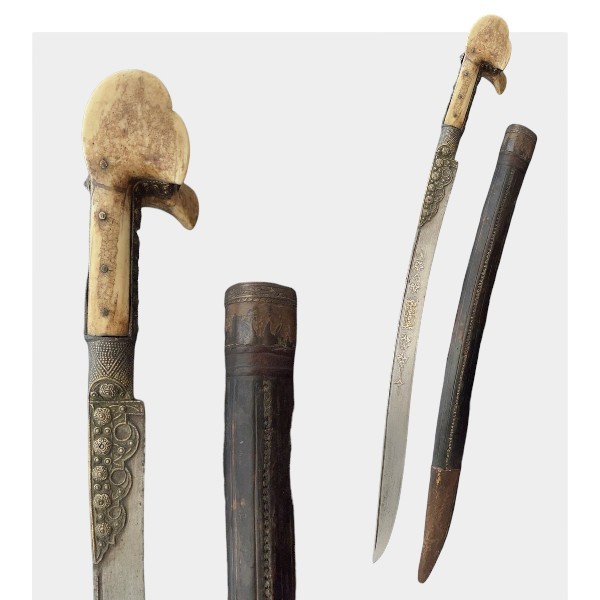
Yatagan of the Ottoman Empire with the inscription: “O Muhammad, be my assistant.” 1824
Original price was: 4,250 $.3,749 $Current price is: 3,749 $.












Updating…
There are no reviews yet.