

This antique sword is perfect for collectors and gifts. Go to the photo albumPhotos of the lot on offer are at the very bottom


Camzolna Sword of an English Official from the 19th Century
Out of stock
Purchase ⚔️ as a gift? For collection in Kyiv, Ukraine: Camzolna Sword of an English Official from the 19th Century
Manufacturer: Unknown.
Country: England
Dating: 19th century
Condition: 7/10
Completeness: Sword with scabbard
Dear Collectors and visitors of the Antique Gallery website, who are looking for a gift, particularly Antique weapons, we present to you: the Camzolna Sword of an English Official from the 19th Century.
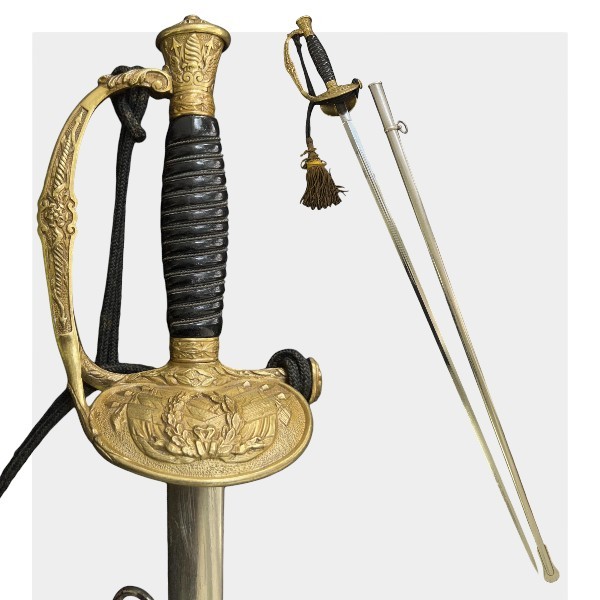
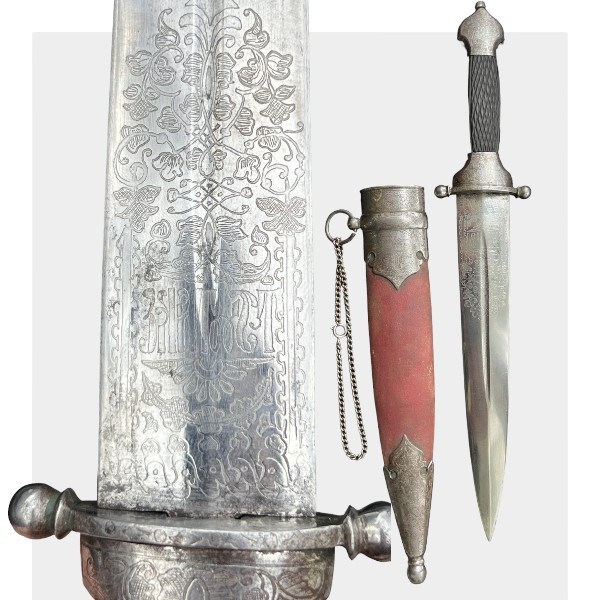
The blade is made of steel, straight, with a three-sided cross-section, featuring grooves on all sides. The blade retains decorative elements with etched floral patterns.
The hilt consists of the grip and guard. All metal parts of the hilt are made of white metal. The guard is formed by an ornamented arc that transitions into a figurative cross-guard, beneath which is secured a figurative relief shield, decorated using the “diamond facet” technique. The grip is metallic and also decorated with the “diamond facet” technique. The head of the grip is conical, adorned with a relief ornament.
The scabbard is wooden, covered with black leather, with a steel protrusion and tip.
Historical Note on the Camzolna Sword of an English Official from the 19th Century:
Diamond Faceting (also known as granulation) is a technique for decorating metal surfaces with small metal beads. This method of embellishment has been used in European art since the 16th century.
Regarding the history of swords with diamond faceting, this was a fairly common form of decoration on swords and sabers used in various periods of history. In the 17th and 18th centuries, diamond faceting became particularly popular on weapons and accessories at the French court. This method of decoration was also applied to swords and sabers in other countries such as Spain, Germany, England, and others.
Today, swords with diamond faceting can be found in museum collections and in private collections of weapon and antique collectors.
The sword is a symbol of nobility. This can be explained by the fact that the sword is nothing more than a “descendant” of the sword.
It found its application in both infantry and cavalry. According to ancient unwritten tradition, duels with cold weapons could only be conducted with swords, which thus became the primary tool for achieving success in a career for the service class. Ultimately becoming a part of court attire, the sword lost its combat purpose and became an attribute of dignity and distinction for the military class – the nobility.
Photo Overview:
Go to the top of the ad

Add a review
Be the first to review “Camzolna Sword of an English Official from the 19th Century”
Related products
-
Sword for officers of all branches and administrations model 1872
Original price was: 620 $.600 $Current price is: 600 $.












Updating…
There are no reviews yet.