

The Cavalry Sabre Parade Model 1889 is a remarkable piece of history. Go to the photo albumPhotos of the lot on offer are at the very bottom

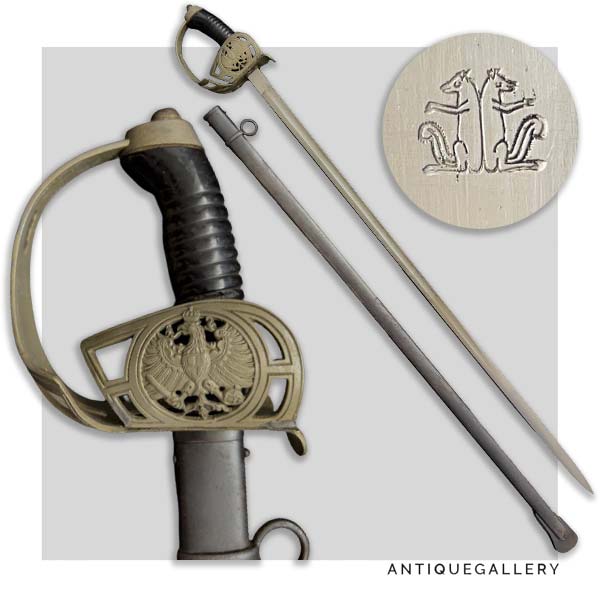
Cavalry Sabre Parade Model 1889, Kingdom of Prussia
The manufacturer, Carl Eickhorn, based in Solingen, was established in 1865 and is one of the most renowned firms specializing in the production of cold weapons. The decorative weapons produced by this company were known for their high quality. The trademark shown in images 5 and 6 was patented in 1906, while images 7-10 depict trademarks from the early 20th century.
This sabre belonged to an officer of the German Imperial Army, the Armed Forces of the German Empire.
It dates back to the reign of Kaiser Wilhelm II of Germany (1888–1918) and the period of World War I (1914–1918).
The blade of the sabre is made of steel, straight, nickel-plated, with an etched pattern, single-edged, and features a double-edged point. The ricasso is distinctly rectangular in shape.
On the left side of the blade, there are the following decorative elements: a production mark in the form of a logo depicting two stylized squirrels looking in opposite directions. This is followed by an image of a floral ornament and military trophies: two crossed sabres, two pikes, and a helmet, along with the depiction of the Prussian royal eagle.
On the right side of the blade, there is an image of a floral ornament and military trophies, as well as an inscription on a wreath decorated with oak leaves, which reads: “Zur Erinnerung an meine Dienstzeit,” translating to “In remembrance of my service.”
The hilt of the sabre consists of several parts:
The grip has an L-shaped bend at the end and a contoured thickening at the beginning (for the index finger). This part is made of black Bakelite and features nine grooves (for better grip of the sabre in hand).
The monolithic crossguard and protective knuckle bow are made of steel with a nickel-plated finish in a pierced configuration. The folding guard features an image of the Prussian royal coat of arms – a crowned eagle with outstretched wings, holding the symbols of monarchical power: a scepter and a globe.
The nickel-plated steel pommel consists of two parts. In the upper part of the element, a protruding tang of the blade can be seen, along with two slots for disassembly (or assembly).
The scabbard of the sabre is made of black steel and shows signs of corrosion. The upper part has a ferrule with two screws, a steel throat with a suspension ring, and a fixed ring. At the end of the scabbard, there is a steel shoe.
Note on the Prussian cavalry sabre model 1889:
Starting in 1905, the steel scabbards of German sabres and sabres began to be painted by manufacturers with black paint or lacquer (for protection against corrosion and to camouflage the weapon).
The cavalry sabre holds historical and cultural value and is a collectible item of antique cold weapons.
Go to the top of the ad
Add a review
Be the first to review “Cavalry Sabre Parade Model 1889, Kingdom of Prussia”
Related products
-


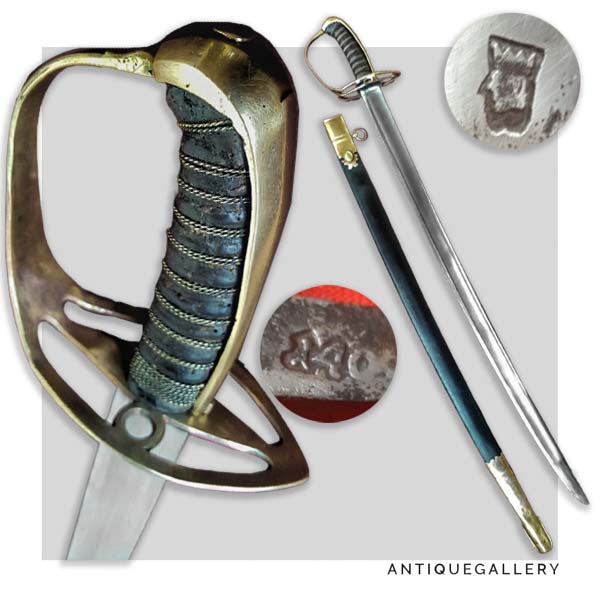
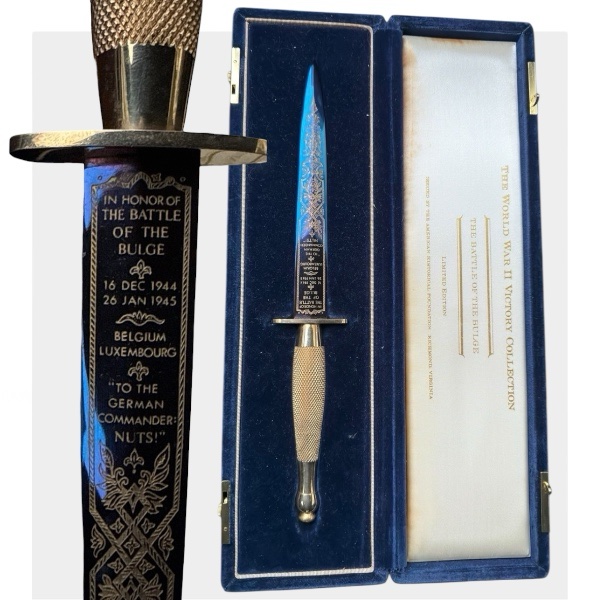
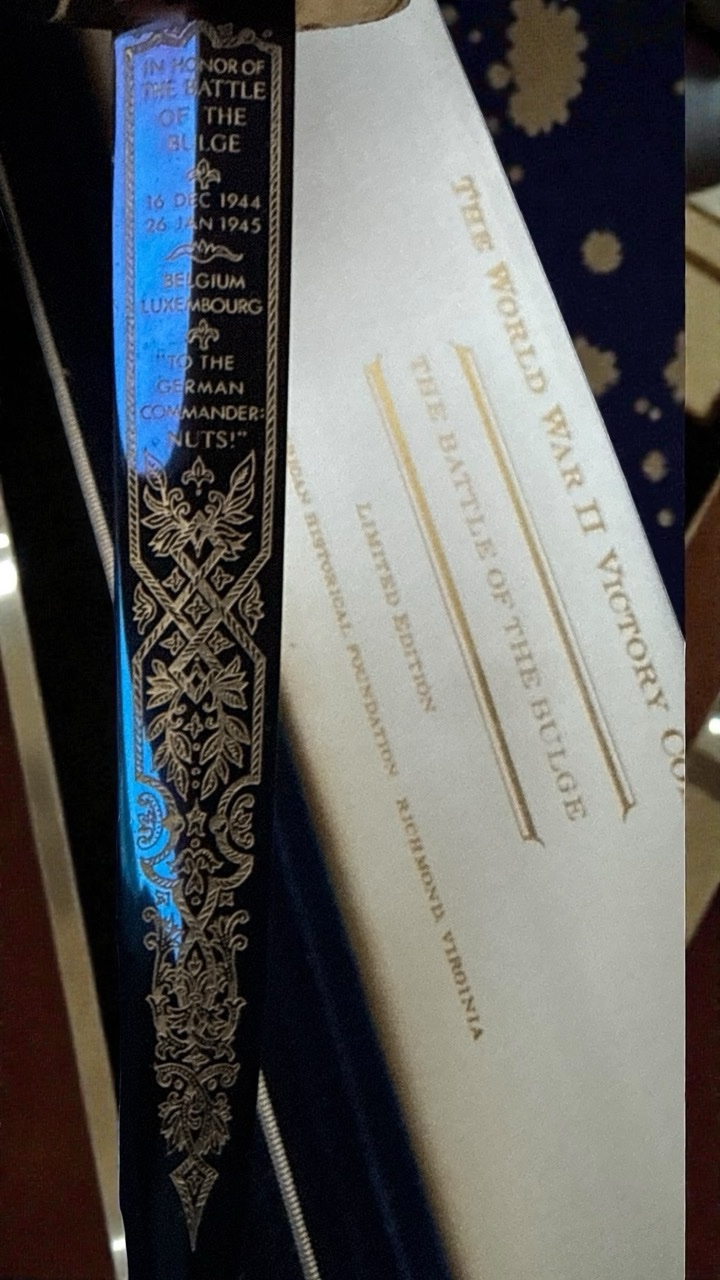
Коллекционный Кинжал Fairbairn-Sykes «Battle of the Bulge»
Original price was: 2,000 $.1,999 $Current price is: 1,999 $. -
-



Updating…
There are no reviews yet.