


Buy⚔️ for a gift and for collecting Parade bayonet-knife rank-and-file fire department, the Third Reich, in Ukraine city of Kyiv
Dear Collectors and guests of the site Antique Gallery, looking for a gift, in particular Antique weapons, your attention is invited: Parade bayonet-knife rank-and-file fire department. Third Reich.
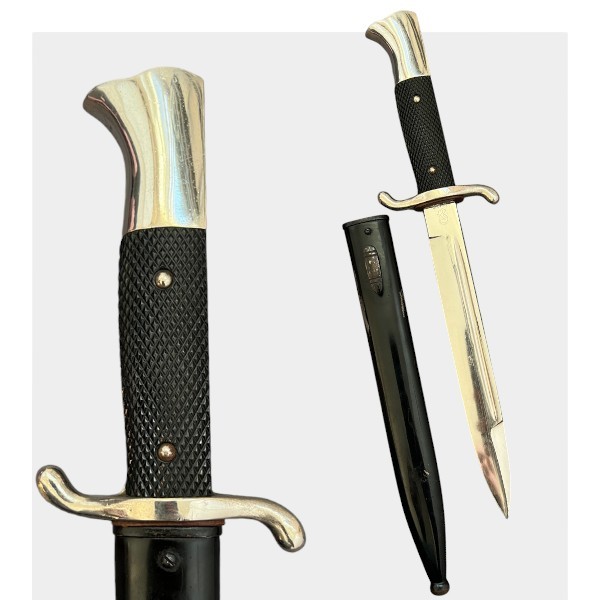
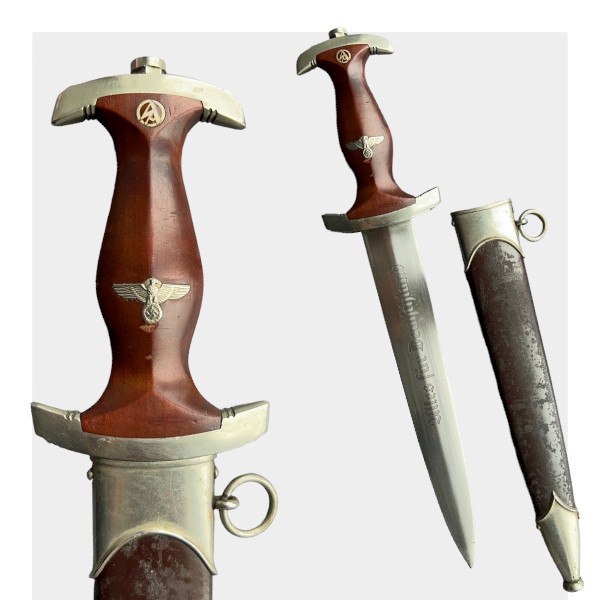
✨ The parade bayonet knife of the ordinary members of the fire brigade is a unique example of a parade weapon, symbolizing the bravery and strength of the firefighters of the Third Reich. Designed for ordinary members of the fire department, this bayonet knife was used during ceremonies, parades and official events. Its design features the classic shape characteristic of parade weapons of the time.
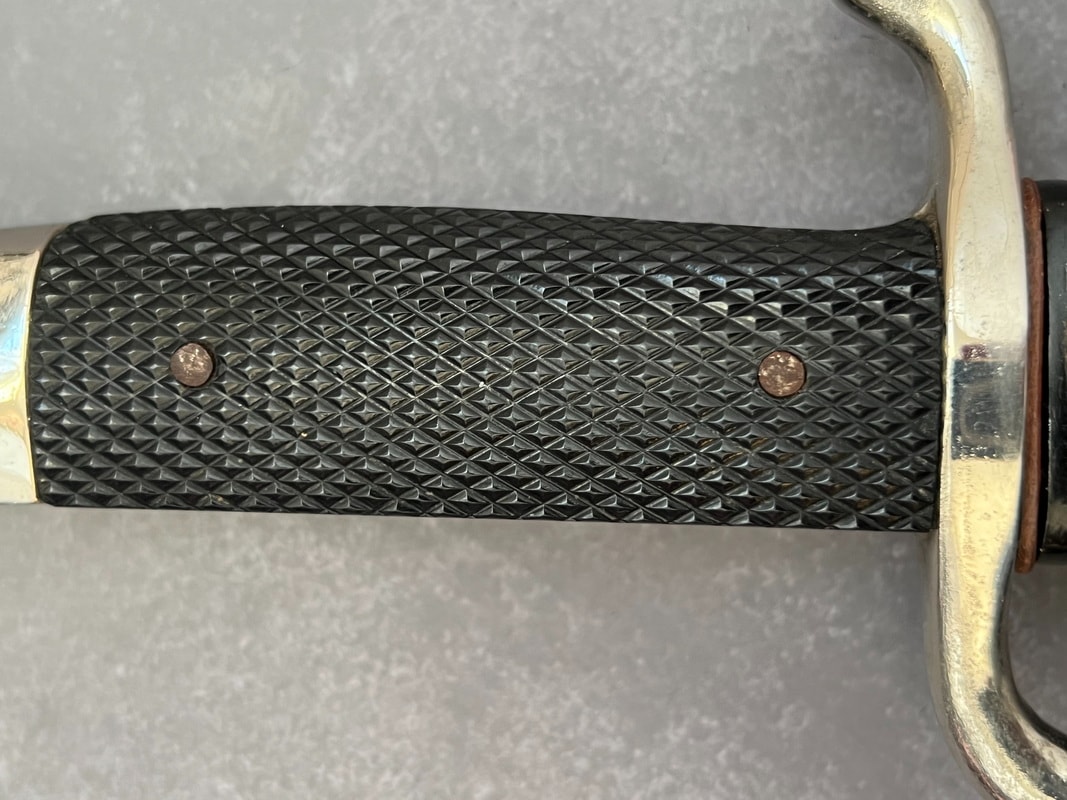
The base of the bayonet hilt is made of steel, the crosshairs are multilateral. The steel head of the hilt is made in the form of a stylized eagle’s head. On both sides of the base of the handle are applied embossed bakelite plates of mesh form of black color fixed with pins – rivets. Metal parts are nickel-plated. On the outside of the part there is a brown colored leather pad that acts as a stopper.
The handle cross pin is steel, nickel-plated, with the ends bent in different directions.

The blade of the bayonet is steel, nickel-plated. The blade is leaf-shaped, quadrangular in cross-section near the heel and triangular in cross-section in the main part. The shaft is of medium size, double-sided.
The blade bears the W.K.C. (WEYERSBERG KIRSCHBAUM & CO; Weyersberg, Kirschbaum & Company) maker‘s mark and a knight’s helmet. This type of blade is called a “shark‘s tooth”.
The bayonet scabbard is made of steel, with black coloring.
Historical Background:
A special parade bayonet was authorized for volunteer fire departments, which had significant differences from the standard K-98 bayonet. It featured a cross with two quilons, the left side pointing upward and the right side pointing downward. At the same time, the bayonet had no weapon mount in the hilt. The other elements, such as the bakelite hilt, blade, scabbard and carrying frog, remained the same as the K-98. It was available in various lengths, with or without saw teeth.
The fire officer’s dirk was distinguished by its length and was worn by both volunteer and professional officers from the mid-nineteenth century to the time of the Third Reich. It was characterized by the absence of swastikas in the trim, retaining the classic design. Most specimens reached up to 50 cm, and some imperial variants were even longer. The handles were made of silver nickel, and the cross was decorated with crossed axes, with spear- or clover-shaped ends. The blade was decorated with engraving with floral motifs and scenes of firefighting.
W.K.C. (Weyersberg Kirschbaum & Co; Weyersberg, Kirschbaum & Company) is a legendary German arms and cold steel manufacturer whose history dates back to the distant 17th century. The company was the result of the merger of two old blade manufacturing companies: the Weyersberg family, who had been forging swords since 1630, and the Kirschbaum family, who had established themselves as leading experts in the field since the late 18th century. In 1883, the two families joined forces to form the W.K.C. company, which quickly became one of the world’s most renowned edged weapons manufacturers.
W.K.C. products have always been known for their quality and craftsmanship. The company manufactured a wide range of weapons, including swords, sabers, dirks, bayonet knives and other types of edged weapons for the army, police, firefighters and various official structures. The company’s products were characterized not only by their reliability but also by their elegant design, making them not only practical tools but also status symbols.


One of the most important distinctions of W.K.C. is the manufacture of weapons for various German military formations, including the army of the Third Reich. During the First and Second World Wars, W.K.C. supplied edged weapons, particularly bayonets and dirks, to various units, including the Army, Navy, and even the Luftwaffe.
The production of fire bayonet knives and parade axes for the fire department is another unique page in the history of the company. These products have become not only necessary items of equipment, but also works of art demonstrating a high level of prestige and symbolic importance.
Although this bayonet knife was not used in combat, it symbolized readiness for service and dedication.
More information about Bayonets of the Third Reich, at the link:
Photo Review:




| Collection | |
|---|---|
| by dating | |
| by country and region | |
| by type | |
| by type of troops |
Add a review
Be the first to review “Parade bayonet knife of the rank and file of the fire department. Third Reich.”
Related products












Updating…
There are no reviews yet.