

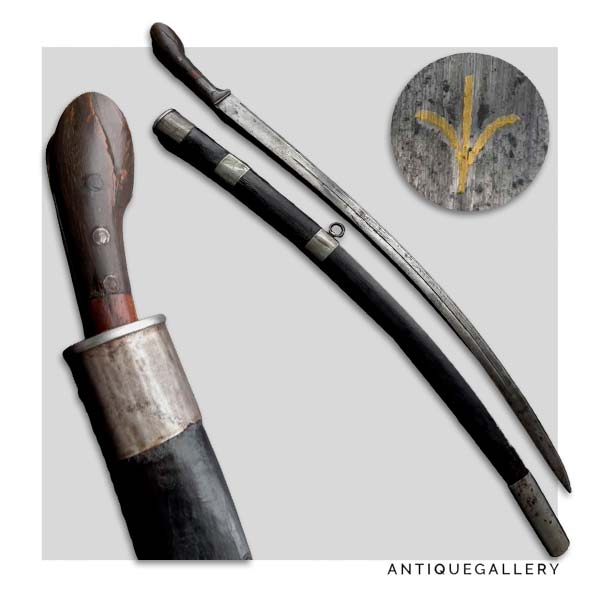
French officer’s sabre from the Revolutionary period, ideal for gifts and collection. Go to the photo albumPhotos of the lot on offer are at the very bottom

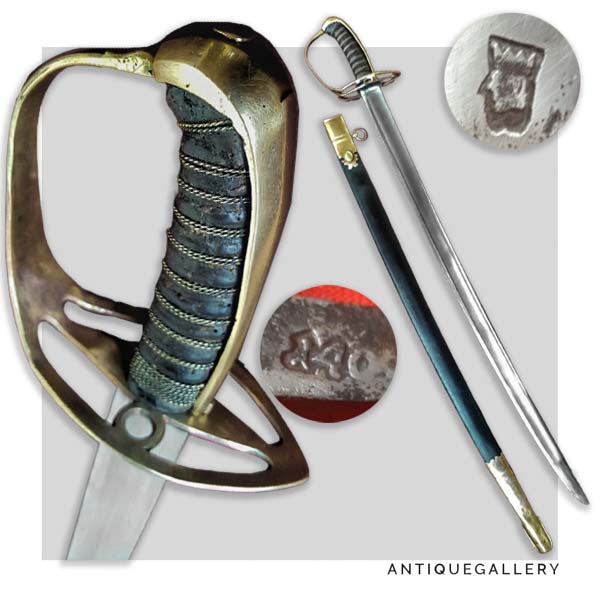
French Officer’s Sabre of Infantry, Revolutionary Period (1800s)
The French officer’s sabre of infantry from the Revolutionary period (1800s) is a remarkable piece of history.
Country: France.
Date: Revolutionary period, 1800s.
Manufacturer: WEYERSBERG SOLINGEN
Original
Condition: The sabre has been significantly restored, with a re-riveted blade, polishing of all components, and replacement of wood and leather on the scabbard.
Completeness: Sabre with scabbard.
Collectible Condition: 5/10.
Esteemed collectors and visitors seeking antique gifts, particularly antique weapons, are presented with the French officer’s sabre of infantry from the Revolutionary period (1800s).
Subfamily of sabres VII b – Non-figurative head. This sabre likely belonged to a junior officer.
461 – Infantry Sabre, Revolutionary Period.
The brass hilt of the French antique sabre features a simple head with a small rivet, transitioning into a long solid back. The flat guard arch leads to an ornate cup of the hilt. The grip is covered with shagreen, adorned with double-twisted copper wire filigree in the form of a chain. The straight blade has a fuller and is stamped with “Cabannes.” The leather scabbard includes two fitting elements, with a mouthpiece featuring a pin.
BLADE is steel, slightly curved, single-edged, with one broad fuller and one narrow fuller near the tang.
The metal parts of the hilt are made of brass. The manufacturer’s mark and serial number are present on the tang of the blade.
GRIP is wooden, covered with leather (shagreen) and wrapped in grooves with metal wire in the form of a chain, forming nine double turns, with the tenth turn solid in the form of twisted wire. A simple head with a small rivet transitions into a long solid back. The guard’s bracket and cup form a single piece, with the bracket featuring longitudinal grooves and an ornate cup of the hilt.
The scabbard has two fitting elements: a mouthpiece with a pin and a movable ring for attaching a belt, with the tip featuring an asymmetrical boot.
Historical Note:
The French Revolution began in May 1789, when the Old Order was overthrown and a constitutional monarchy was established. In September 1792, the monarchy was replaced by the First French Republic, and in January 1793, King Louis XVI was executed. This initiated a period of political instability, culminating in Napoleon’s appointment as First Consul in November 1799, which is often regarded as the end of the revolution. The French Revolution is one of the most significant events in French history, leading to radical changes in French society and marking a pivotal moment in the history of Western democracy, transitioning from an era of absolutism and aristocracy to one of democracy involving broader segments of the population.
The history of the French Revolution can be broadly divided into two periods:
1789-1794: From the beginning of the Estates-General to the fall of Maximilien Robespierre and his supporters. During this time, two constitutions were adopted. In July 1789, uprisings began, with the urban poor, later known as sans-culottes, looting landmarks. Initially, they attacked the Hôtel des Invalides and then besieged the royal prison at the Bastille. After three days, the fortress’s defenders surrendered. Louis was forced to convene the Estates-General. During this session, a decision was made to increase taxes, but this did not lead to improvements. France was on the brink of famine. Losing all hope for France’s salvation, Louis attempted to flee abroad but was caught in time, and the Jacobins ordered his execution by guillotine.
During this period, four political parties existed in France: the Feuillants (supporters of constitutional monarchy), Girondins (constitutional radicals), Jacobins (radical democrats), and Royalists (supporters of absolute monarchy).
1794-1799: From Robespierre’s fall to Napoleon Bonaparte’s rise to power. During this time, the country was governed by the Directory.
Photo Overview:
Go to the top of the ad


Add a review
Be the first to review “French Officer’s Sabre of Infantry, Revolutionary Period (1800s)”
Related products



Updating…
There are no reviews yet.