


Buy⚔️ for a gift and for collecting Romanian officer’s army dirk model 1930 in Ukraine city of Kyiv
Dear Collectors and guests of the site Antique Gallery, looking for a gift, in particular Antique weapons, to your attention is offered: Romanian officer’s army dirk of the sample of 1930 year
The 1935 German Army Officer’s Dirk, made by the renowned “F.W. Holler” Solingen company, is a true relic of the Third Reich, characterized by refinement and exquisite craftsmanship. This dirk was used by infantry officers at official ceremonies, emphasizing the status and prestige of the owner. Made of high quality materials and decorated with details, it is ideal for collectors of antique weapons or connoisseurs of military history. This dirk not only preserves the spirit of the era, but also symbolizes the craftsmanship of German gunsmiths. ⚔️
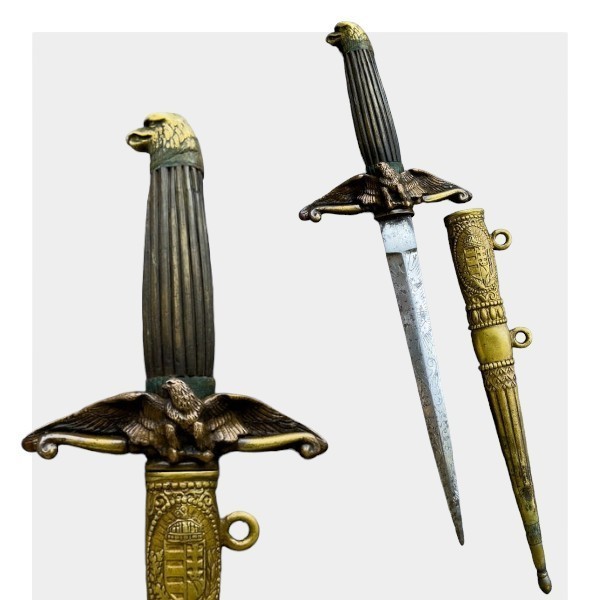
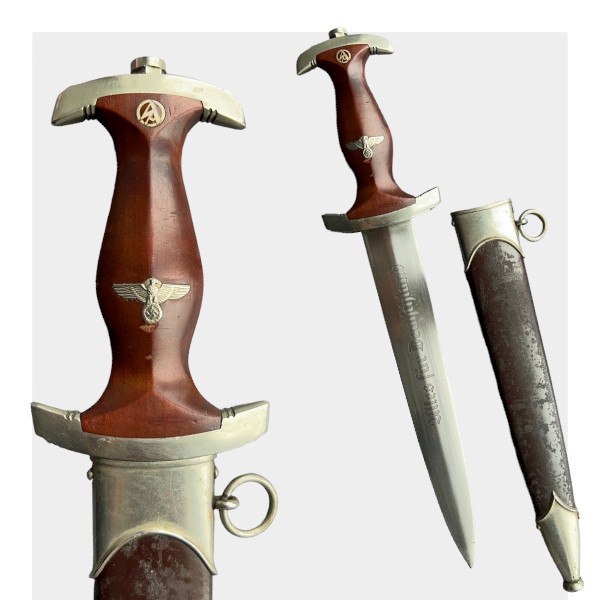
The blade is steel, nickel-plated rhombus cross-section double-bladed, decorated with plant ornament and the coat of arms of Romania on one side, and on the other side – the monogram of Carol II, who became a symbol of the dictatorship in Romania in 1930-1940.
The ivory handle has a smooth surface. The tip is depicted in the form of an eagle’s head, which symbolizes power and military might.
The crosshairs are metal, decorated with geometric patterns, finished with scrolls, and the Romanian coat of arms with a crown emphasizes the belonging of the dirk to the elite armed forces of the country. The reverse side bears the inscription “NIHIL SINE DEO” – “GOD WITH US”, reflecting the fascist ideology of the time.


The heel of the blade bears the branding of the famous German company “F.W. Holler” Solingen.
Karol II monogrammed dirks are rare historical artifacts that not only reflect the era of the dictatorship, but also represent an exquisite example of weapons craftsmanship.
Historical Background:
The 1930 Romanian Army officers’ dirks appeared in the context of the interwar period, when Romania was trying to strengthen its army and enhance the national spirit. This period was marked by intensive efforts to modernize the country’s armed forces. Dirks served as an important element of officers’ uniforms and reflected the high social and military status of their owners.
The design of the 1930 model dirk was influenced by common European fashions in armament, but retained unique features characteristic of the Romanian tradition.
It was worn at both official military ceremonies and parades, symbolizing discipline, responsibility and honor.
Romania, like many other European nations, actively renewed its military traditions after World War I, and dirks became an integral part of the uniform for officers of all ranks.
“F.W. Holler Solingen:
Founded in 1866 in Solingen, Germany.
The company “F.W. Holler” originally specialized in the production of knives and cutlery. The company was officially registered in 1883.
Production of edged weapons probably began during the Franco-Prussian War of 1870-1871, and over time the firm gained a reputation as one of the leading manufacturers of edged weapons.
During World War I, “F.W. Holler” produced bayonets from the 1898/1905 model in small quantities. Between 1933 and 1945, when Germany entered World War II, the company expanded production, producing a variety of edged weapons, including 1884/98 bayonets.
The company had the code RZM: M7/33.
The company ceased to exist in 1974 .
Such a dirk will become an exclusive property for collectors of antique weapons and history lovers. It can serve as part of the interior, emphasizing the aesthetic taste of the owner and giving the room a special flavor.



Photo Review:


| Collection | |
|---|---|
| by dating | |
| by country and region | |
| by type | |
| by type of troops |
Add a review
Be the first to review “Romanian officer’s army dirk of 1930 pattern”
Related products
-
Yatagan of the Ottoman Empire with the inscription: “O Muhammad, be my assistant.” 1824
Original price was: 4,250 $.3,749 $Current price is: 3,749 $. -
Sword for officers of all branches and administrations model 1872
Original price was: 620 $.600 $Current price is: 600 $.












Updating…
There are no reviews yet.